

Global investment in transport infrastructure accelerated during the third quarter of 2026, driven by comprehensive highway expansion initiatives in the Middle East, Central Asia, and North America. Concurrent with roadway expansion is the widespread updating of passive roadside safety standards. Jurisdictions are increasingly enforcing strict vehicle containment criteria, such as MASH TL-4/TL-5 in North America and EN 1317 containment levels across Europe. These criteria necessitate the deployment of heavier-gauge highway guardrails (W-beam and Thrie-beam profiles), placing rigorous mechanical demands on cold roll forming production machinery.
Forming Challenges in Heavy-Gauge Structural Steels
Standard highway barriers historically utilized 2.5 mm to 2.7 mm carbon steel coils. Modern high-containment barriers frequently require continuous processing of 3.0 mm to 4.2 mm structural steel strip (such as Q355 or S355JR grades) with yield strengths surpassing 355 MPa. Forming these heavy sections introduces specific mechanical obstacles:
- High Bending Moments and Elastic Recovery: As stock thickness increases, the resistance to permanent deformation rises exponentially. Substantial elastic recovery causes longitudinal curvature (camber and bow) and transverse cross-sectional distortion if springback is insufficiently compensated in the tooling design.
- Multi-Axis Punching Tolerances: Guardrail installation relies on precise modular bolting to vertical I-beam or C-post supports. Splice slots and post-mounting holes must maintain strict cumulative pitch tolerances (within ±1.0 mm across 4.3-meter sections) despite high material flow rates.
- Drive Train Stress: Shaping deep W-beam and triple-wave Thrie-beam corrugations from heavy coil demands continuous high torque, resulting in rapid gear tooth and bearing degradation on standard cantilevered or chain-driven machines.
Essential Machine Architecture and Tooling Design
To produce heavy-duty crash barriers that comply with international road safety certifications, cold roll forming production lines require specific engineering implementations:
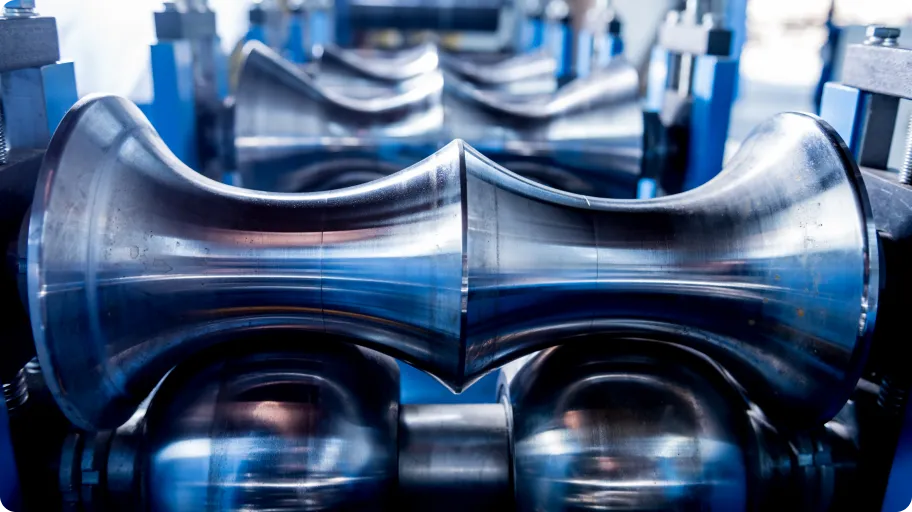
First, structural rigidity must be prioritized. A robust architecture utilizes independent cast iron stands or rigid double-housing frames linked via dedicated individual reduction gearboxes and universal joint drive shafts. This layout distributes drive torque uniformly across all roll shafts, eliminating rotational play and preventing edge slippage during deformation.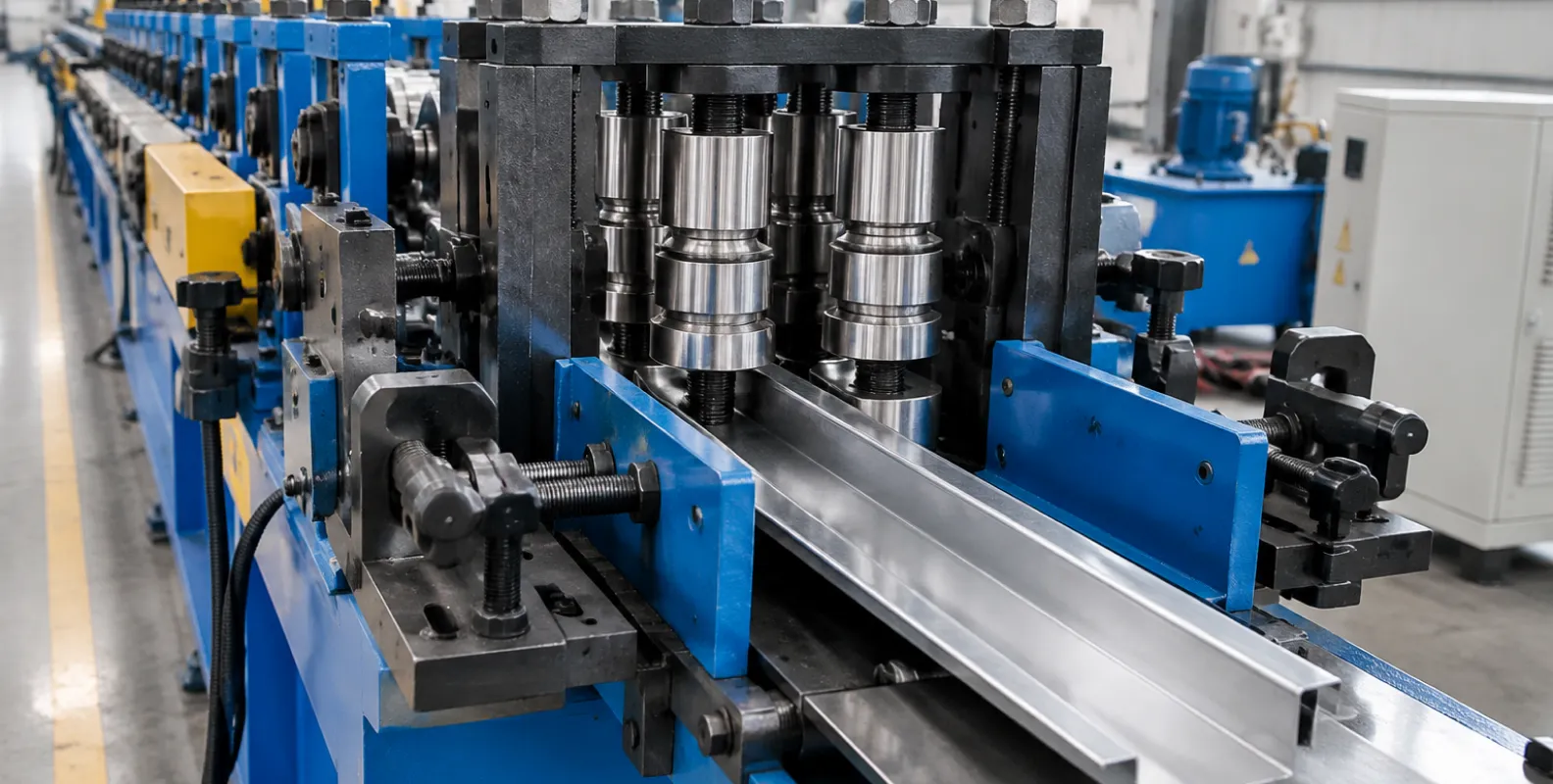
Second, progressive deformation distribution must be optimized. Engineering the roller progression across 18 to 22 forming stations ensures gradual plastic deformation. The initial passes establish the outer corrugation valleys, while intermediate and finishing passes complete the central crown. Vertical calibration stations with side-roller guide clusters are integrated at the exit section to eliminate side bow and stabilize beam flatness.
Third, high-capacity inline hydraulic punching units must be deployed prior to the forming zone. Controlled by high-precision closed-loop servo feed systems, these hydraulic presses blank out slotted mounting patterns with zero material distortion before the strip undergoes cold bending.
Highway Guardrail Manufacturing Solutions
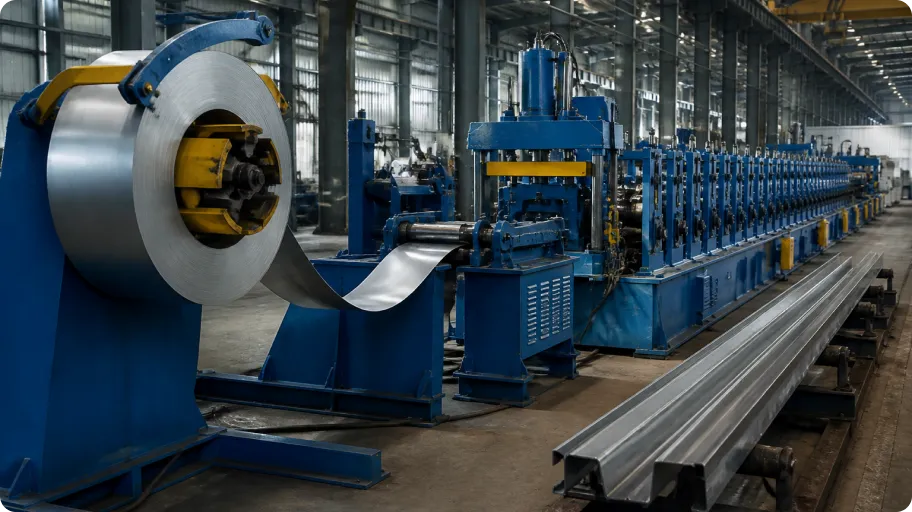
Addressing the safety requirements of modern highway engineering requires machinery engineered for high torque and consistent tolerance control. Tonghe Machinery (THRONCH) designs and manufactures complete cold roll forming lines for two-wave (W-beam) and three-wave (Thrie-beam) guardrails, transition panels, and crash barrier posts. Through finite element simulation of forming progressions, robust gearbox-driven roll stands, and synchronized hydraulic cutoff units, our equipment provides industrial fabricators with the manufacturing reliability necessary to fulfill large-scale highway safety contracts worldwide.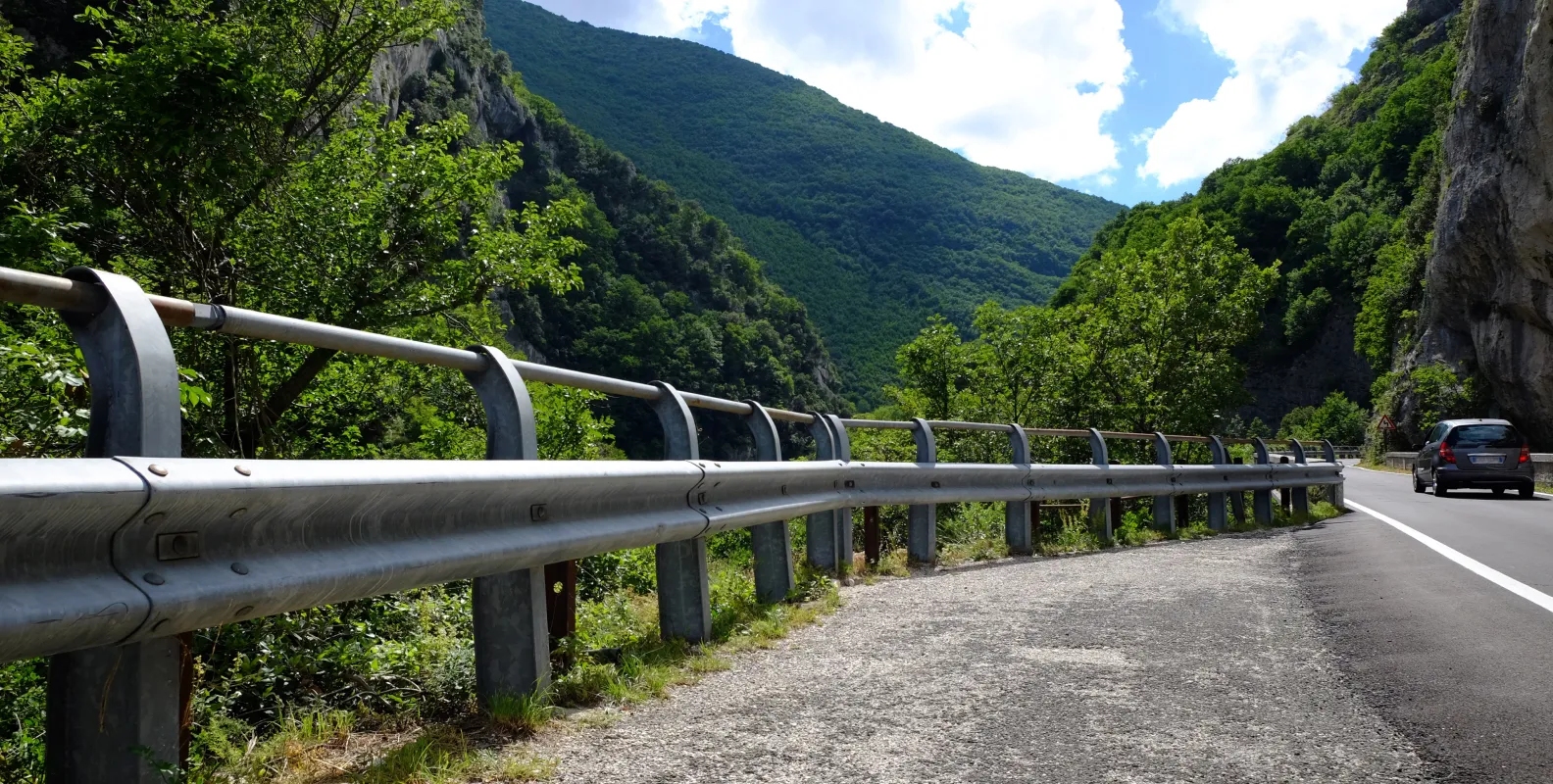
-

THRONCH
Cold Roll Forming Machine Manufacturer
THRONCH is a direct manufacturer specializing in custom cold roll forming lines and welded pipe mills. With over a decade of engineering expertise, we share technical insights and deliver high-precision