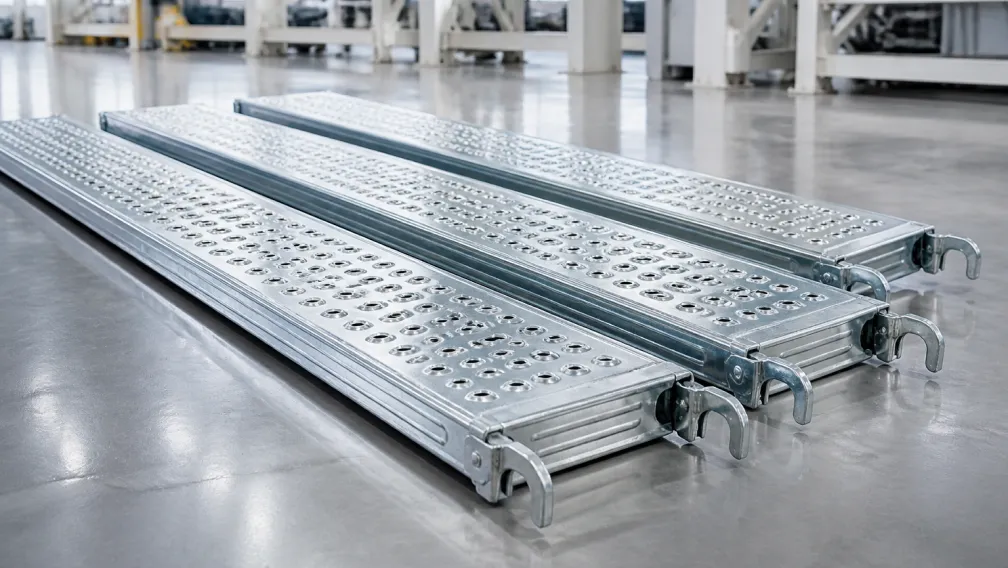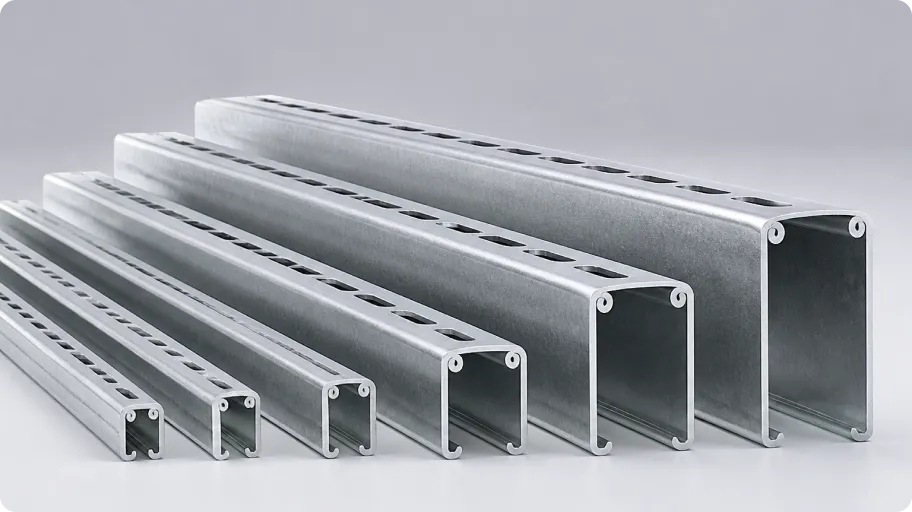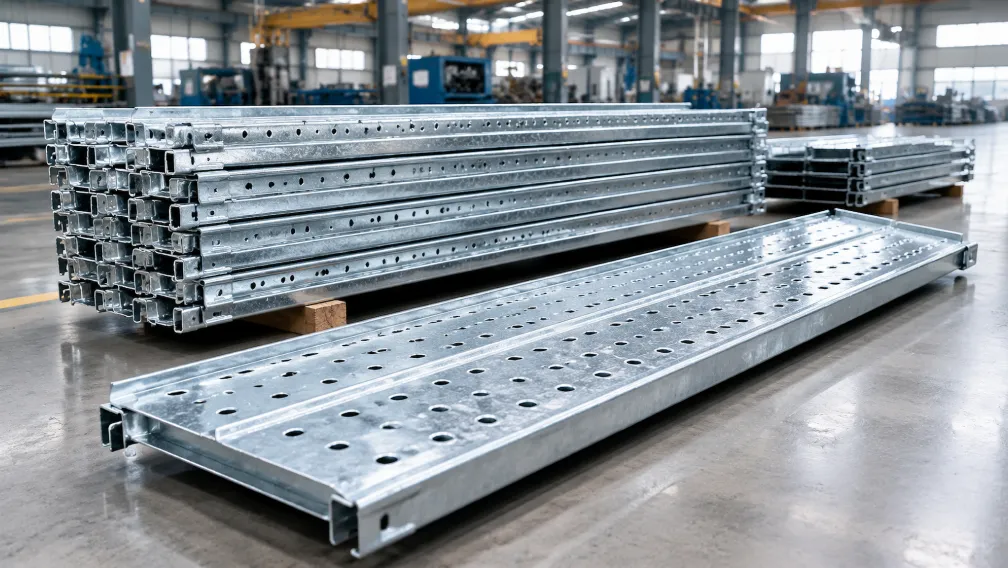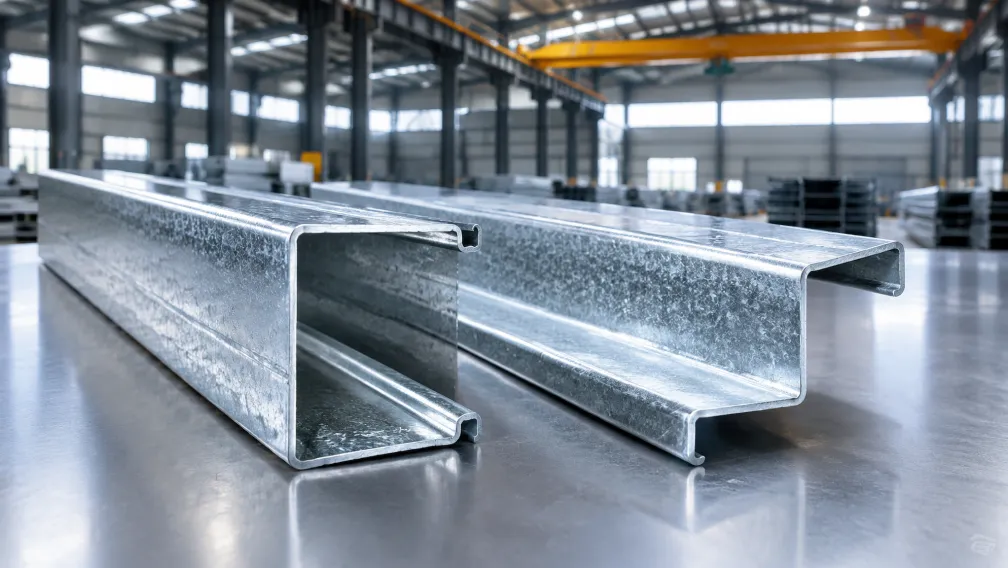


Scaffolding steel planks, also called steel boards or walk boards, are the load-bearing walking and working surfaces of a scaffold system. A plank spans between transoms or ledgers and carries workers, tools, and materials at height, so its design is governed by safety standards rather than by ordinary structural practice. The section is roll formed from galvanized strip into a shallow box profile with an anti-slip perforated top surface and stiffened side walls, with hook ends that drop onto the scaffold tube. Compared with timber boards, steel planks do not rot, delaminate, or burn, their capacity is consistent from piece to piece, and they last ten years or more in rental fleets. This guide covers the standards that govern plank design, the standard sizes and features, material and finish choices, and how planks are produced on a roll forming line.
Safety Standards That Govern Steel Planks
Three regulatory frameworks cover most export markets, and each approaches plank safety differently:
OSHA (United States)
OSHA 29 CFR 1926.451 sets the performance requirement: each scaffold platform component must support, without failure, its own weight plus at least four times the maximum intended load. Platforms must be fully planked between uprights, deflection is limited so the platform does not spring or rock underfoot, and the 4:1 safety factor applies to the plank as a structural component. OSHA does not prescribe dimensions; it prescribes performance, so manufacturers prove capacity by test and calculation.
EN 12811 (Europe)
EN 12811-1 classifies working platforms into six load classes, from class 1 at 0.75 kN/m² uniformly distributed load for inspection-only duty up to class 6 at 6.0 kN/m² for heavy masonry work with material storage on the platform. The standard also sets minimum platform widths, from 600 mm upward depending on class, and requires slip resistance and restraint against uplift. Planks sold into the EU are tested and rated to a load class, and the rated class must be marked on the product.
BS 1139 and Other Frameworks
BS 1139 covers metal scaffolding materials in the UK and Commonwealth markets, and many Middle East and Asian specifications reference it alongside EN 12811. Australia and New Zealand apply AS/NZS 1576, which follows the same performance logic: proof load testing, deflection limits, and slip resistance. A plank design destined for export should be tested against the strictest target market, because a plank that passes EN 12811-1 class 4 and OSHA's 4:1 factor generally satisfies the others.
Standard Sizes and Design Features
The international market converged on a small set of plank dimensions. Widths of 210 to 250 mm cover single-plank walkways, with two or three planks side by side forming a full working platform; wide planks of 420 to 500 mm serve double-width applications. Section height runs 38 to 50 mm, with 45 mm the common export standard. Thickness is 1.2 to 2.0 mm of pre-galvanized strip, and lengths run from 1 to 4 m, with 2, 3, and 4 m the volume sizes. A 3 m plank in 1.5 mm strip weighs roughly 13 to 15 kg, light enough for one worker to handle overhead.
Three design features separate a working plank from a plain formed channel. First, the top surface carries a pattern of raised punched holes: the holes let water, mud, and small debris fall through while the raised rims grip boot soles, giving the slip resistance the standards require. Second, the side walls are formed with return flanges or stiffening ribs, because the long shallow section would otherwise buckle under a point load between supports. Third, the ends carry hooks, formed from the same blank or welded on, that drop over the scaffold tube and lock the plank against lateral movement and uplift; hook geometry must match the 48.3 mm tube diameter that dominates system scaffolding.
Materials and Surface Treatment
Base material is structural carbon steel strip, Q235B or equivalent for standard duty and Q355B where higher loads or thinner gauges are specified. Yield strength of 235 to 355 MPa gives the stiffness the deflection limits demand without making the plank too heavy for manual handling.
Finish is almost always galvanized, but the route matters. Pre-galvanized strip, Z80 to Z275 coating, is the volume choice: the coil arrives coated, the plank needs no treatment after forming, and the cost is lowest. Its weakness is the cut edges and punched holes, which carry only a thin zinc film and show rust first in coastal or tropical service. Hot-dip galvanizing after fabrication coats every surface including edges and hole walls and suits rental fleets and harsh climates, at roughly 15 to 25 percent higher processing cost. Painted or powder-coated planks appear in some Asian domestic markets but chip under scaffold handling and are rare in export orders.
How Scaffolding Steel Planks Are Manufactured
A steel plank line is a cold roll forming line with two specialized stations, built on the principles described in our article on what a cold roll forming machine is. The process runs: decoiling and leveling of the galvanized strip, high-speed punching of the anti-slip hole pattern, roll forming of the box profile with its side-wall stiffeners, and flying cut-off to length. Hook ends are added downstream, either pressed from the plank ends on a separate station or robot-welded, depending on the design.
The punching station defines the line. The anti-slip pattern is not decorative: hole diameter, pitch, and the height of the raised rim decide both the slip rating and the drainage, and the pattern must hold position tolerance over a 4 m length at line speeds of 15 to 25 m/min. Lines use a synchronized press with dedicated die sets per pattern. Forming follows with 18 to 22 stands to close the shallow box and fold the stiffening ribs without cracking the zinc coating at the bends, which is where roll design and pass sequence earn their keep. A complete scaffolding plank production line adds automatic stacking and bundling so the line runs with one operator.
Buyers comparing a dedicated plank line against a general scaffolding steel plank roll forming machine should note that width changes on a plank line are handled by roll spacer adjustment, so one line covers the full 210 to 500 mm width range, while thickness changes need roll gap re-shimming. An automatic roll forming machine configuration with length-batch control and auto packing is the standard choice for export-oriented plants running mixed orders.
Quality control on a plank line focuses on three checks: hole pattern position gauged against the length datum, section height and width measured at the cut-off on every bundle, and periodic load testing of sample planks to the target standard. Export orders increasingly arrive with a third-party inspection clause, and a line that logs per-bundle dimensions makes that inspection a formality rather than a negotiation.
How to Specify Steel Planks for a Project or Fleet
Four inputs settle a plank specification. First, the governing standard and load class: EN 12811-1 class for Europe, the OSHA 4:1 performance factor for the US, BS 1139 or AS/NZS 1576 elsewhere, and the marked rating must match the intended duty. Second, dimensions: width and length to fit the scaffold bay layout, with 45 mm height as the compatibility default. Third, thickness and material grade, which trade weight against capacity. Fourth, finish: pre-galvanized for normal duty, hot-dip galvanized for coastal, tropical, or rental-fleet service. Specifying all four at order stage avoids the common problem of receiving planks that fit the tube but carry no test rating for the market they will work in.
Get a Plank Line Proposal for Your Size Range
Send us your plank drawings or the width, height, thickness range, and hole pattern you plan to produce, with your target output, and THRONCH engineers will return a line configuration with punching station, roll pass design, and hook station matched to your product. Standard lines are completed in 35 to 50 days, and every line passes a 48-hour trial run with real galvanized strip before packing. Contact us at amy@thronch.com.
-

THRONCH
Cold Roll Forming Machine Manufacturer
THRONCH is a direct manufacturer specializing in custom cold roll forming lines and welded pipe mills. With over a decade of engineering expertise, we share technical insights and deliver high-precision