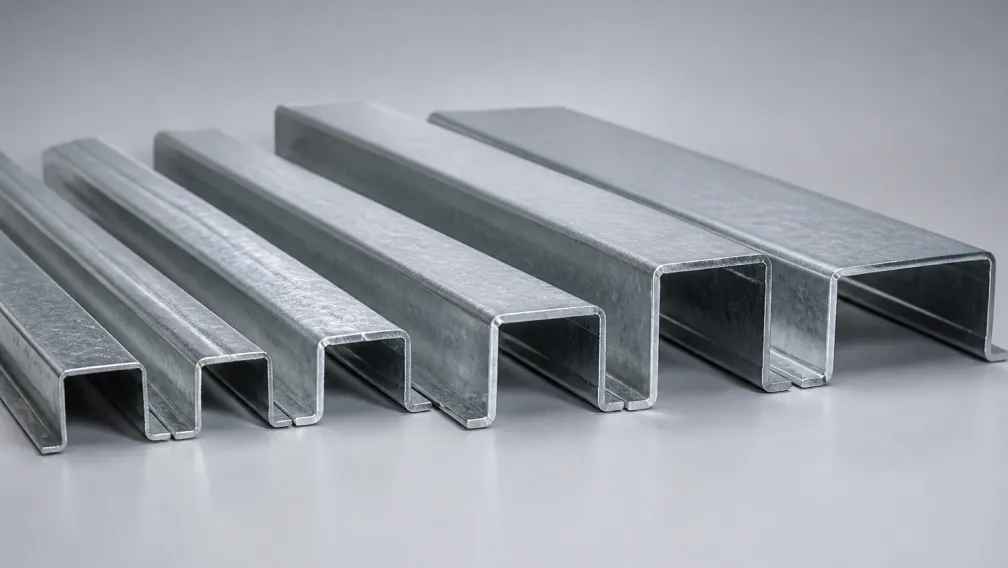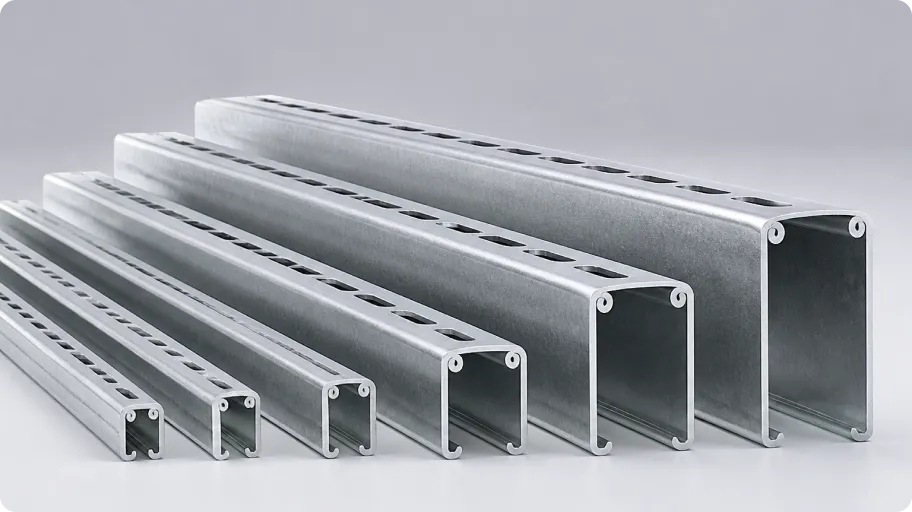


Hat channels—widely specified as metal furring channels, omega profiles, or top-hat battens—are cold-formed galvanized steel sections shaped like a top hat in cross-section. The symmetric profile features a flat central crown, two angled or vertical webs, and two outward-turning wing flanges that fasten directly to concrete, masonry, steel framing, or roof trusses. This geometry creates a rigid, noncombustible mounting plane while leaving a continuous air cavity for thermal insulation, moisture drainage, or electrical conduits. Because a single commercial tower or industrial roof consumes tens of thousands of linear meters of hat channel, dimensional consistency, screw-retention strength, and production speed govern both contractor acceptance and factory profitability. This technical guide covers the structural and nonstructural standards regulating hat channels, standard imperial and metric dimensions, steel grades and coatings, primary building applications, and the high-speed cold roll forming process used to manufacture them.
Standards Governing Metal Hat Channels and Furring Channels
Engineering codes divide hat channels into two distinct categories: nonstructural interior drywall furring and structural exterior or load-bearing sub-framing. Specifying the wrong class leads to excessive deflection or code rejection during inspection.
Nonstructural Furring Standards (ASTM C645, AISI S220, and EN 14195)
In North America, interior ceiling and wall furring channels are governed by AISI S220 (which replaced ASTM C645 in modern International Building Code editions), with installation practices defined by ASTM C754. Nonstructural hat channels are restricted to interior applications where axial loads do not exceed 200 lb and transverse wind or pressure loads stay under 10 psf. Typical base metal thicknesses run from 18 mils (25 gauge, 0.45 mm) to 30 mils (20 gauge drywall, 0.75 mm). In Europe, EN 14195 covers metal framing components for gypsum board systems, defining yield strength, zinc coating mass, and dimensional tolerances for omega furring profiles.
Structural Hat Channel and Roof Batten Standards (ASTM C955, AISI S240, and AS/NZS 4600)
Exterior rainscreen sub-girts, facade cladding rails, and roof battens carry wind uplift, dead weight of metal or fiber-cement panels, and maintenance loads. North American structural hat channels follow AISI S240 (formerly ASTM C955) and AISI S100 design rules, starting at 33 mils (20 gauge structural, 0.84 mm) and extending through 43 mils (18 gauge, 1.09 mm) and 54 mils (16 gauge, 1.37 mm). Minimum base steel thickness must be at least 95 percent of design thickness. Across Australia, New Zealand, and Southeast Asia, top-hat roof battens are engineered to AS/NZS 4600 using high-tensile G550 steel, allowing thinner gauges (0.48 to 1.20 mm) to bridge roof truss spans of 900 to 1,800 mm without excessive deflection.
Standard Hat Channel Sizes, Gauges, and Nomenclature
North American hat channels follow the CSSBI and AISI designation format, such as 087F125-18 or 150F125-43. The leading digits state the section depth in hundredths of an inch (087 = 7/8 in or 22 mm; 150 = 1-1/2 in or 38 mm), the letter F identifies a furring channel, 125 indicates the 1-1/4 in (32 mm) crown bearing width, and the trailing number gives minimum base metal thickness in mils. Stock lengths are 10 ft (3.05 m) and 12 ft (3.66 m), packed ten pieces per bundle.
Outside North America, metric top-hat battens cover a wider depth range—typically 22 mm, 35 mm, 40 mm, 61 mm, 75 mm, 96 mm, and 120 mm—with crown widths from 35 to 60 mm and standard cut lengths of 4.0 to 7.5 m for commercial roofing and solar racking.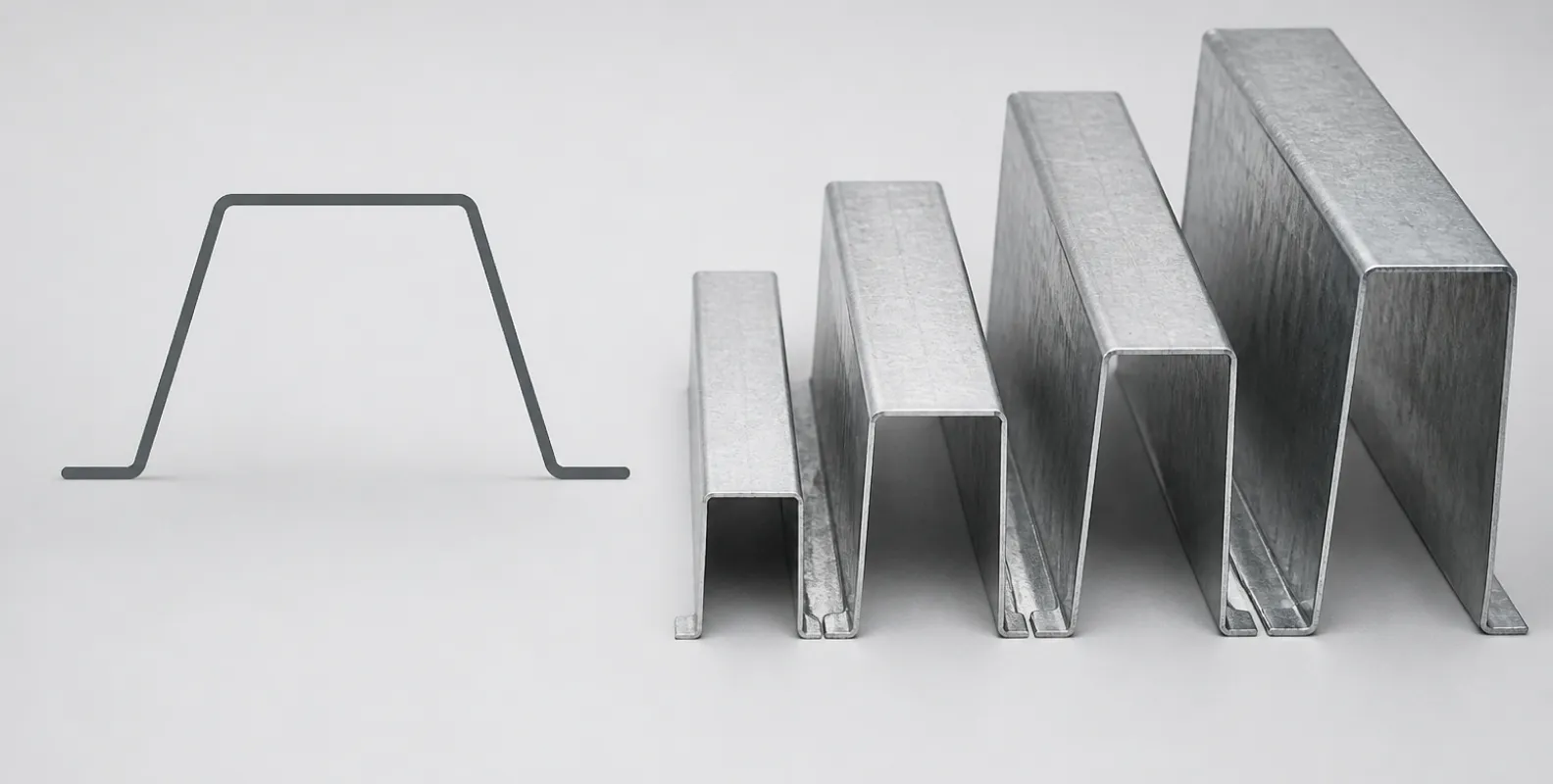
| Section Type / Code | Depth | Nominal Gauge / Thickness | Typical Yield Strength | Primary Application |
|---|---|---|---|---|
| 087F125-18 (Light Furring) | 22 mm (7/8 in) | 25 ga / 18 mil (0.45 mm) | 230 MPa (33 ksi) | Interior drywall ceilings, masonry wall leveling |
| 087F125-30 / 150F125-30 | 22 or 38 mm | 20 ga DW / 30 mil (0.75 mm) | 230 MPa (33 ksi) | Heavy multi-layer gypsum boards, acoustic ceilings |
| 087F125-33 / 150F125-43 | 22 or 38 mm | 20–18 ga STR (0.84–1.09 mm) | 230–345 MPa (33–50 ksi) | Exterior cladding sub-girts, ventilated rainscreens |
| 150F125-54 (Heavy Structural) | 38 mm (1-1/2 in) | 16 ga / 54 mil (1.37 mm) | 345 MPa (50 ksi) | Heavy facade panels, exterior soffits, light purlins |
| Metric Top Hat (40–120 mm) | 40–120 mm | 0.48–1.20 mm | 550 MPa (G550 / S550GD) | Metal roof battens, steel shed framing, solar rails |
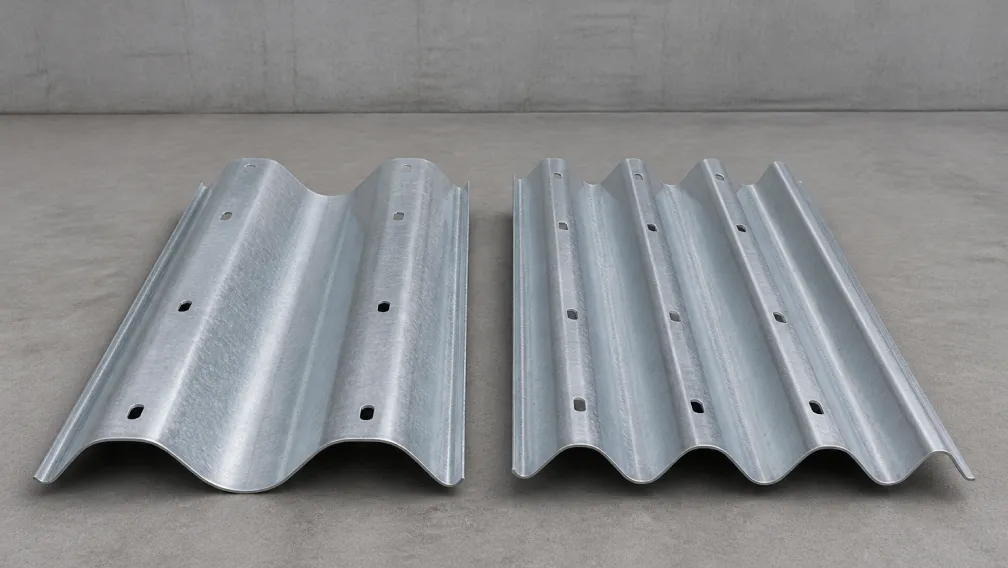
Two geometric details affect field installation. First, light-gauge 25-gauge furring channels are frequently formed with hemmed (folded-back) wing edges, eliminating raw sheared steel borders that cut installers' hands and stiffening the narrow flange against fastener pull-through. Second, the flat crown face is often knurled or lightly embossed during forming so self-drilling drywall or cladding screws bite immediately without skating across smooth zinc.
Steel Grades and Corrosion Protection
Base material follows ASTM A1003 or EN 10346 hot-dip galvanized structural strip. Interior nonstructural furring channels typically use 33 ksi (230 MPa) steel—such as DX51D or Q235B equivalents—with a G40 (Z120) or G60 (Z180) zinc coating. Structural hat channels in 18 and 16 gauge step up to 50 ksi (345 MPa, S350GD) with G60 or G90 (Z275) galvanizing to resist condensation inside exterior wall cavities.
Roof battens and top-hat purlins in coastal or tropical markets specify G550 (550 MPa minimum yield strength) coil coated with Z275 zinc, AZ150 aluminum-zinc (Galvalume), or Zinc-Aluminum-Magnesium (ZAM) alloy. High-tensile 550 MPa steel has low elongation—often under 5 percent—meaning bend radii must be engineered accurately to prevent cracking along the outer crown corners.
Key Applications Across Commercial and Industrial Construction
- Masonry and concrete wall furring: Fastened directly to uneven block or poured concrete walls, 22 mm or 38 mm hat channels create a plumb plane for gypsum board while leaving space for rigid foam insulation and wiring.
- Suspended and acoustic ceiling grids: Cross-furred perpendicular to 38 mm cold-rolled carrying channels or mounted on resilient sound-isolation clips, hat channels decouple ceiling drywall from floor joists to improve STC acoustic ratings.
- Ventilated rainscreen facades: Structural 18-gauge and 16-gauge hat channels act as horizontal or vertical sub-girts supporting fiber-cement, terracotta, or aluminum composite cladding, maintaining a drained rear air cavity.
- Metal roofing battens and solar sub-framing: High-tensile metric top hats replace timber roof battens in industrial warehouses and residential steel roofs, offering termite immunity, straight rooflines, and direct screw pull-out resistance for standing-seam or corrugated sheets.
How Hat Channels Are Manufactured on a Roll Forming Line
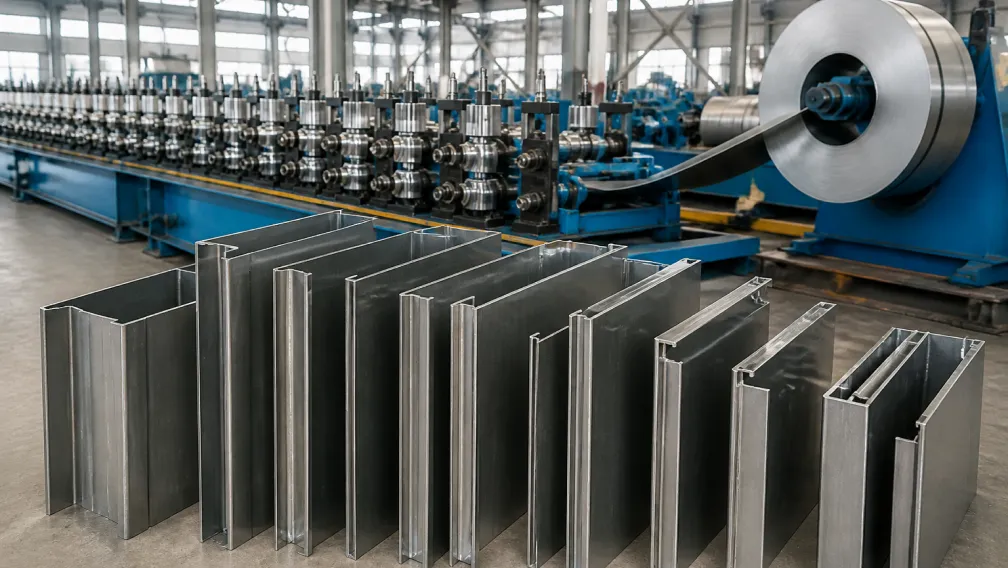
Because hat channels are symmetric, narrow-strip profiles produced in massive linear volumes, continuous cold roll forming is the only commercially viable production method. The progressive bending mechanics follow the principles detailed in our overview of what a cold roll forming machine is.
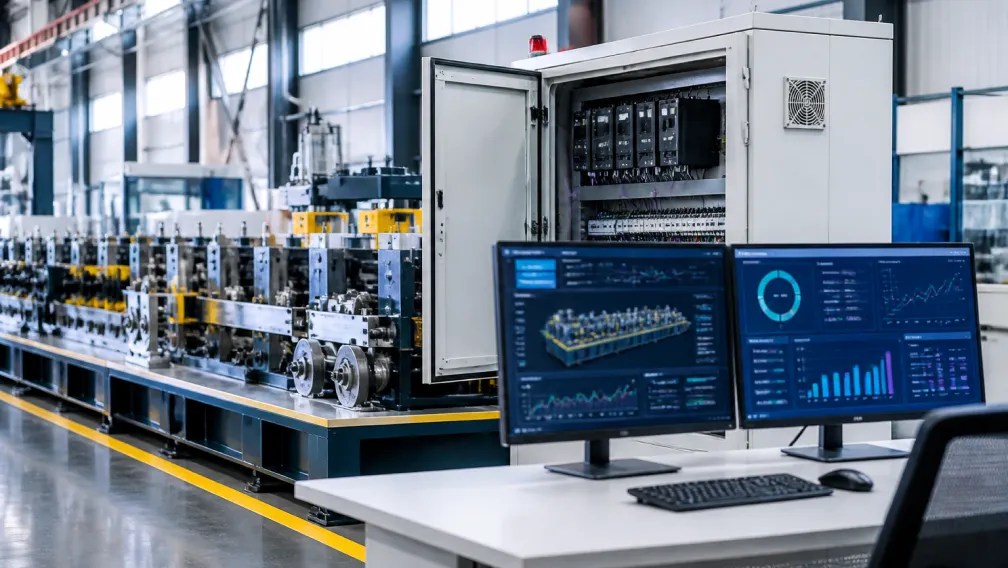
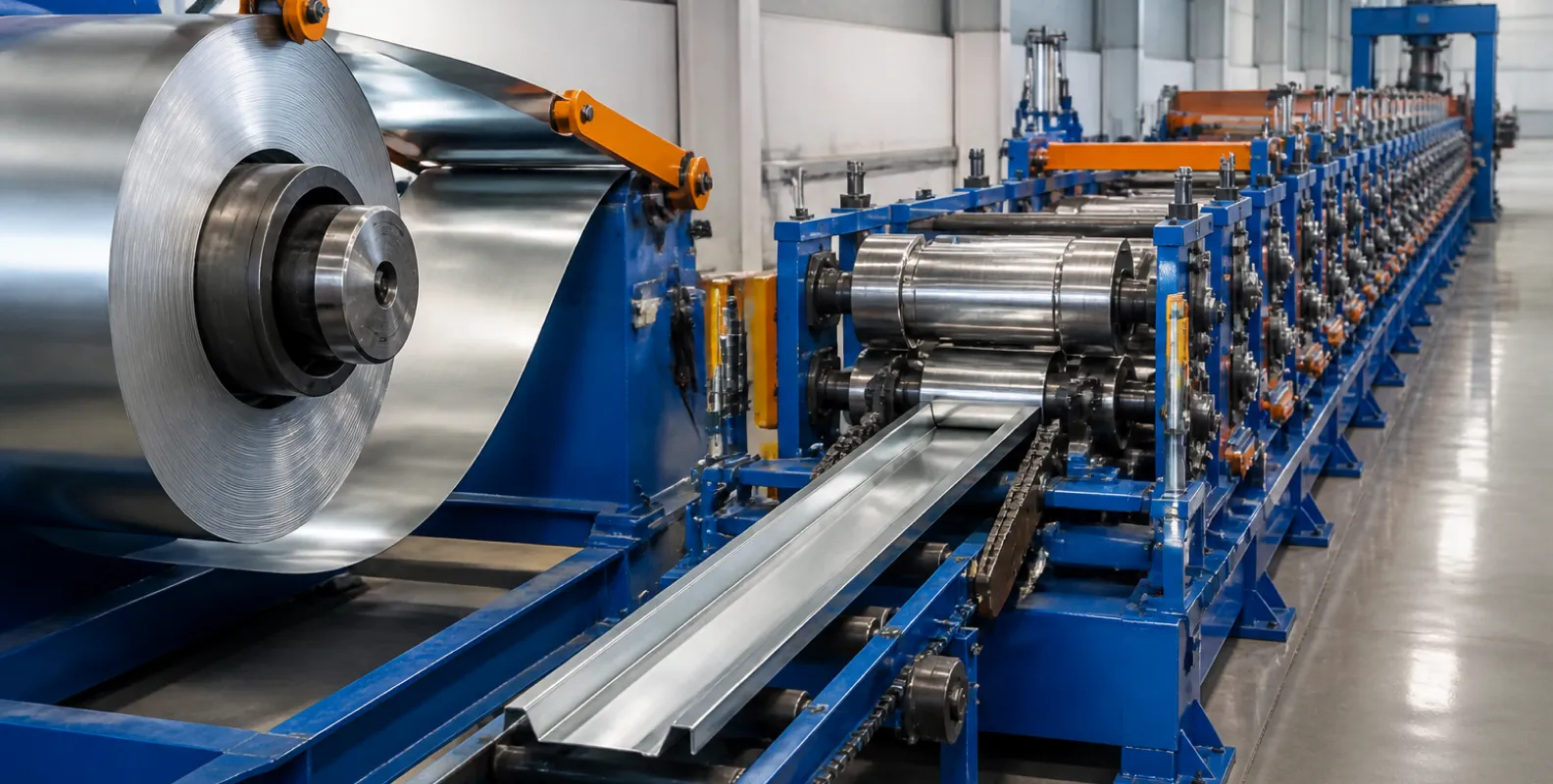
A dedicated hat channel roll forming machine runs at substantially higher line speeds than heavy structural purlin mills. Light-gauge drywall furring lines (0.45 to 0.85 mm) typically operate at 30 to 60 meters per minute, while heavy structural hat and G550 batten lines (0.8 to 2.0 mm) run at 15 to 30 meters per minute. A complete production line integrates five synchronized stages:
- Uncoiling and strip guidance: A motorized or hydraulic decoiler feeds slit galvanized coils (typically 80 to 250 mm wide) through a precision entry guide. Dual-head decoilers or coil-end welders are added on high-output lines to minimize coil-change downtime.
- In-line embossing, knurling, and punching: Prior to bending, a knurling roller stand impresses the anti-slip screw pattern onto the crown zone. For structural roof battens or solar hat channels requiring pre-punched mounting slots or drainage notches, a servo-driven hydraulic punch press operates in-line at ±0.2 mm pitch accuracy.
- Progressive cold roll forming: Light furring profiles pass through 12 to 16 roll stands; structural and hemmed-edge profiles require 16 to 20 stands. Forming G550 high-tensile roof battens demands carefully calculated over-bending passes to compensate for elastic springback, using vacuum-hardened Cr12MoV or D2 rollers (HRC 58–62) with polished profiles to prevent zinc buildup and galling.
- Straightening and high-speed flying cut-off: A turks-head straightening block at the exit removes upward bow and lateral twist. Because halting a 50 m/min line for every 3-meter cut destroys throughput and leaves roller dwell marks, high-speed lines employ a servo flying shear with profile-matched blades that tracks strip speed and slices cleanly without collapsing the angled webs.
- Nesting and automatic bundling: Angled webs allow hat channels to nest tightly inside one another. Automated run-out tables count pieces into 10-piece or 20-piece nested stacks, strap them, and transfer bundles for palletizing.
Fabricators supplying mixed building framing schedules—combining hat channels with drywall studs, tracks, or light roof purlins—frequently evaluate changeover efficiency across their steel structure roll forming machine fleet. Where a plant produces multiple hat depths (such as 22 mm and 38 mm drywall furring, or 40 mm to 96 mm roof battens) on one footprint, a modular profile production line equipped with quick-change cassette rafts swaps entire pre-shimmed roller sets via overhead crane in under 30 minutes. Integrating PLC batch-length control and automated stacking on an automatic roll forming machine enables one operator to run mixed contractor cutting lists with minimal remnant waste.
How to Specify a Hat Channel Roll Forming Line
Four production parameters establish the right machine layout. First, define the thickness and yield-strength envelope: a light 0.45–0.85 mm drywall furring line uses lighter shafts and higher drive speeds than a 1.0–2.0 mm structural or G550 batten line, and combining both extremes on one mill compromises either speed or shaft rigidity. Second, confirm edge and surface features—specifically hemmed wing flanges and crown knurling—so dedicated forming and embossing stands are built into the pass schedule. Third, specify the full depth and crown-width range to decide between a single-profile high-speed line and a cassette-raft interchangeable line. Fourth, check target monthly tonnage and cut lengths: short 3.05 m drywall pieces at 50 m/min require a servo flying shear rather than a stop-to-cut hydraulic press to avoid severe cycle bottlenecks.
Request a Hat Channel Roll Forming Line Proposal
Send us your hat channel cross-section drawings, depth and flange dimensions, steel grade and thickness range (0.45 to 2.0 mm), and target monthly output. THRONCH engineers will prepare a complete line specification covering decoiler setup, knurling or servo punching stations, roll pass design, and flying cut-off speed. Standard lines are manufactured in 35 to 50 days and pass a 48-hour trial run with real galvanized coil prior to shipment. Contact us at amy@thronch.com.
-

THRONCH
Cold Roll Forming Machine Manufacturer
THRONCH is a direct manufacturer specializing in custom cold roll forming lines and welded pipe mills. With over a decade of engineering expertise, we share technical insights and deliver high-precision